A wave gives you six spins, and player documentation prices them at 100, 150, 200, 250, 300 and 350 gold — 1,350 for the full ladder. A fresh run starts with 450 gold, which buys exactly the first three. The question is not how many spins are left but whether your current army can clear the next wave; if it can, stop.
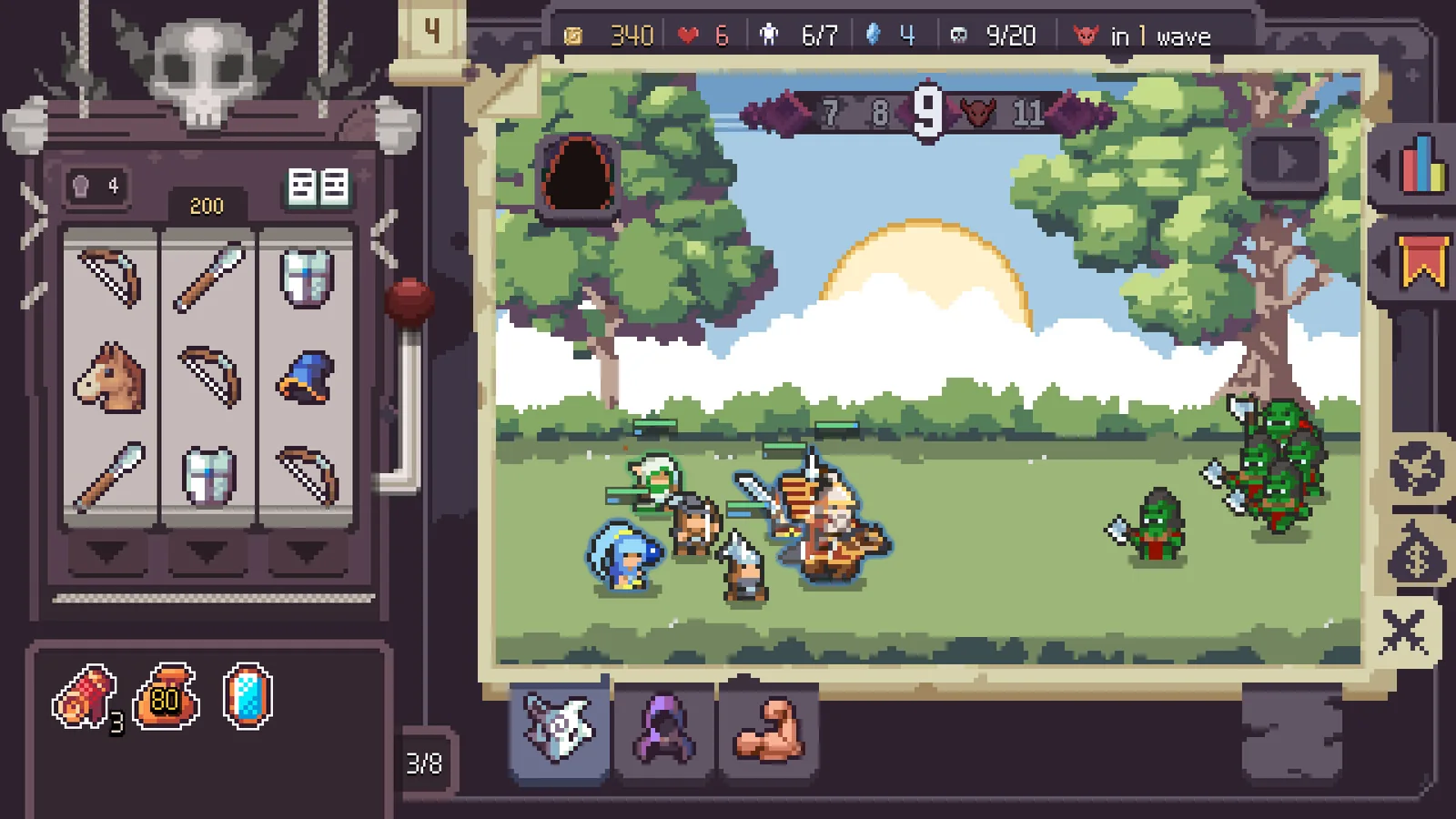
The spin button is the only place Slotbound converts gold into hope, and the exchange rate gets worse with every press. The reset each wave is the important part: the expensive spin you are considering now will be a cheap one in ninety seconds.
The price ladder
| Spin | Cost | Running total |
|---|---|---|
| First | 100 | 100 |
| Second | 150 | 250 |
| Third | 200 | 450 |
| Fourth | 250 | 700 |
| Fifth | 300 | 1,000 |
| Sixth | 350 | 1,350 |
The sixth spin costs three and a half times the first. At 450 gold you can afford half the ladder and no mistakes, which is a useful calibration for the whole run.
What resets and what does not
Because the ladder resets, the marginal spin is cheap again next wave. That is an argument for stopping early: the same 100 gold buys a first spin when your board is a wave older and your needs are clearer.
The stability test
Before every spin after the first, ask whether the army you have can clear the next wave. If yes, the spin is optional. Optional is not free: it is 100 to 350 gold that will not be there for the wave that kills you.
- Can this army clear the next wave? If yes, bank.
- Is a line one cell short and a nudge available? Fix it for free, then reassess.
- Would the unit fit? At the cap the machine refuses the spin, so absorb first.
- Is this the sixth spin? It costs 350; the next wave’s first spin costs 100.
The cap is a stop sign
A fresh run is documented at five unit slots. Unit Expansion raises it, with eight as the community-reported ceiling. The machine checks the cap before it takes your gold, so a full army is not a strong army — it is an army with no room for the line you are about to buy.
Absorb before you spin, not after. The eaten unit is gone, the recipient gains a level and a slot opens. Lock the keepers first; Hold to Absorb is fast and indifferent.
Board state, decision
| Board state | Decision | Why |
|---|---|---|
| Two lines paying, army stable | Stop | Gold compounds; extra bodies compete for slots. |
| One line one cell short, nudge unused | Nudge first | Free, and it preserves the board. |
| No pairs, army thin, spins left | Spin | You are buying bodies, not chasing lines. |
| At the cap, no promotion ready | Absorb first | Spins are blocked; a full board is a dead end. |
| Sixth spin, stable board, purse low | Stop | Next wave’s first spin costs 100, not 350. |
When the full ladder is correct
There is a time to spend 1,350 gold: the next wave is a Judgment or a boss, your army is one body short, and the gold has no better use. The test is not “can I afford it” but “does the unit change the fight”. If not, the sixth spin is a donation.
The opposite mistake is hoarding through a wave you could have saved. Gold earns no interest, and a lost battle costs a life. Spend to survive the wave in front of you.
For the geometry behind the prices, read the board guide. For what the expensive spins chase, read the jackpot guide. If the answer is nothing, the greed economy guide explains when banking beats spending.
FAQ
How much does a spin cost?
Player documentation prices the six spins at 100, 150, 200, 250, 300 and 350 gold. The first spin of each wave resets to 100.
Do unused spins carry over?
No. You get six per wave, and the remainder is lost when the wave ends.
Does gold carry between waves?
Yes, according to the same player documentation. Spins and the ladder reset; the purse does not.
Should I always take all six spins?
No. Take the sixth only when the next wave is a real check and one more unit changes it.
Why is the spin button disabled?
You are at your army cap. Absorb a unit, or lose one, and the machine will take spins again.
The 3×3 board
Eight lines, nine cells and a centre square that sits on half of them.
Jackpots
Nine identical symbols, eight paying lines and a Prism at the end — documented fact versus player data.
Greed economy
Banking gold is a real strategy with a real failure state: a Judgment fought with your savings on the table.