Banking gold is a legitimate strategy and a bad default. Cores such as Chalice of Greed and Coin Sack pay you for gold you have not spent, which makes hoarding profitable — until a lost battle or a lost Judgment takes the savings with the run. Hold gold when your board is stable and the next spin would overflow; spend it when the next wave is a check you might fail.
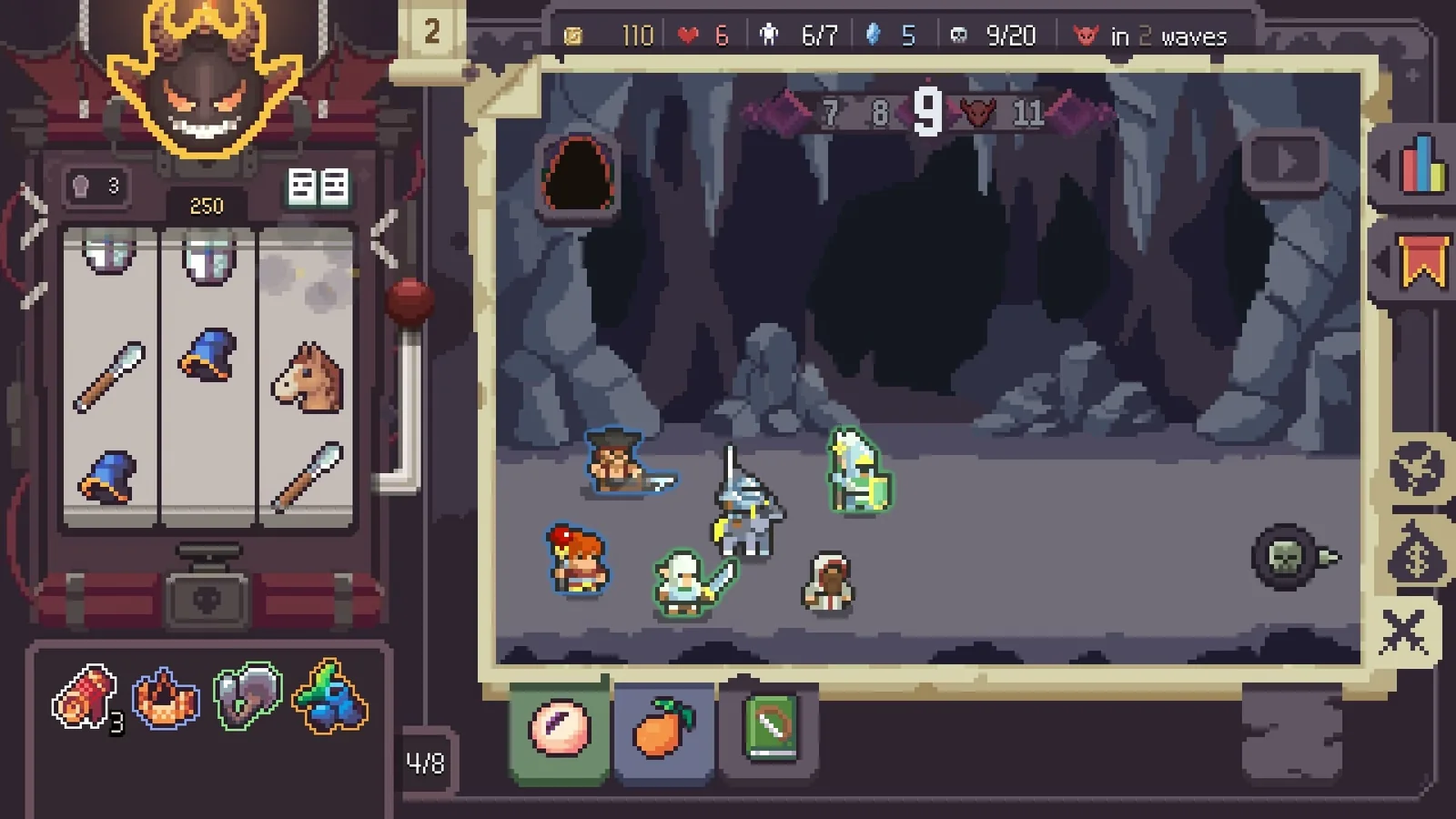
Gold in Slotbound is not a score. It is an option: the ability to buy a spin next wave without having planned for it. Banking keeps that option instead of converting it into units, and it only becomes a strategy when something pays you for holding it.
What banking actually is
Gold persists between waves; spins do not (community guide). That asymmetry is the whole basis of the economy build. A spin you decline is not lost value — the gold stays, and next wave’s ladder starts cheap again. Banking is refusing to convert gold into bodies you do not need yet, while a Core converts the leftover into more gold. The trap is that this logic sounds like it applies to every wave. It does not.
The Cores that pay for holding
| Core | Effect as players describe it | What holding costs you |
|---|---|---|
| Chalice of Greed | Banks gold on a win, up to a cap, and pays out when the battle starts. | A losing spin forfeits the savings, so one bad board can wipe the bank. |
| Coin Sack | Banks gold for each unused spin at battle start and cashes out when the sack fills. | The sack is lost if you lose that battle, which makes it a bet on surviving. |
Both Cores pay out only if the battle goes well; that is the design telling you greed is a position you take from strength, not desperation.
The trap: banking through a check
Wave five is a Judgment, and losing a Judgment ends the run (community guide). Wave ten is the other check players treat as a boss. Banking into either is not greed, it is a coin flip with your savings on the table — and players report the savings going with the run when the wave is lost.
10,000 gold is a milestone, not a plan
There is an official achievement for reaching 10,000 gold. That makes it a legitimate target and a terrible default. An achievement does not care whether your frontline survives; your frontline does. The milestone rewards a run already safe enough to stop spending — not a run that skipped its early upgrades to get there. If you want it, layer it onto a stable run as a second objective. If the run is not stable, you are not doing an economy run. You are doing a normal run with fewer units.
Board state to gold decision
| Board state | Gold decision |
|---|---|
| Clearing waves with units to spare | Bank. Skip the fifth and sixth spins; they are the expensive ones. |
| Losing a unit every wave | Spend. A body now beats interest later. |
| Entering a Judgment | Spend everything you can convert into survivability. |
| One promotion from a real carry | Spend on the item that protects the promotion, not on another spin. |
| Stable, chasing the milestone | Hold, but cash out the moment the next check appears. |
Cash-out timing
- Cash out one wave before a check, not on it. Shopping after the wave has started is not shopping.
- Keep a reserve that covers the first spin of the next wave. That is the option the strategy protects.
- Spend on a spin only when the spin changes the board — not when it might.
- Do not reroll the shop to celebrate a payout. The reroll is how a bank becomes a memory.
The spend side lives in the spin economy; the survival side in the wall build. Greed is only a build when the wall holds.
FAQ
Does gold carry between waves?
Yes, according to community documentation — gold persists, while unused spins reset at the end of each wave. That is why declining an expensive spin is a real saving rather than a forfeited allowance.
Which Core is better for banking?
They reward different habits. Chalice of Greed wants wins, so it suits a board already clearing. Coin Sack wants unused spins, so it suits a player who deliberately stops early. Pick the one your existing play already feeds.
Can I lose banked gold?
Yes. Players report that savings from banking Cores are forfeited when the battle or the spin goes wrong, and losing a Judgment ends the run outright. Treat a full bank as a reason to cash out, not a reason to feel safe.
Spin economy
The price ladder, the six-spin allowance and the test that tells you to keep your gold.
Tank + healer
The best-documented build in the game, and the damage problem nobody mentions until wave ten.
Achievements
Sixty-four achievements, three hidden, and one that asks for the other sixty-three. The categories, the wall achievements, and a route that does not waste runs.